
Practical AI and automation
Make AI useful inside real work.
We identify a bounded task, examine the information and decisions around it, then build an AI-assisted workflow your team can supervise. The starting point is not a model or a trend. It is a piece of work worth improving.
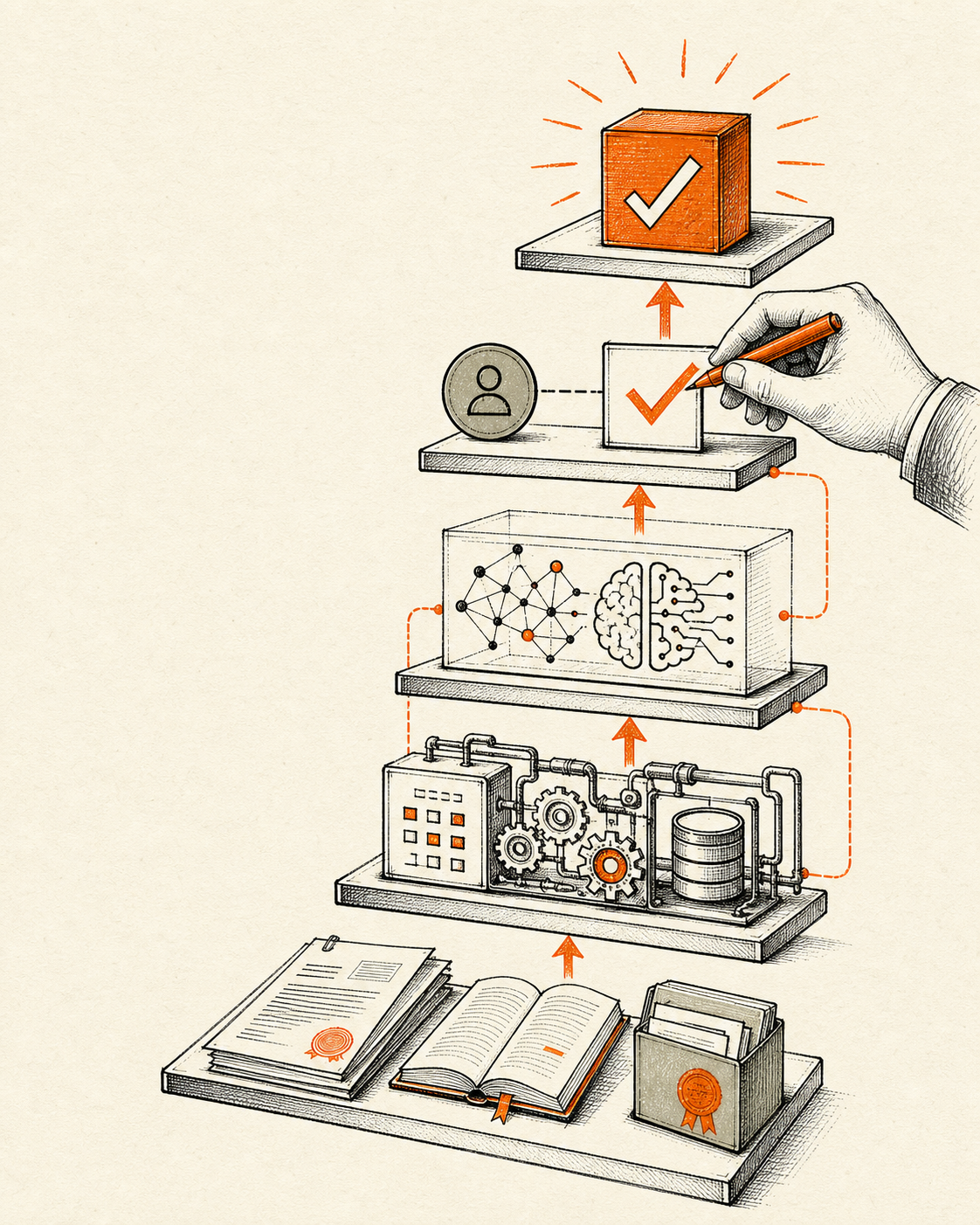
Start with the work. Keep responsibility visible.
AI can summarise, classify, retrieve and draft, but a capable model does not automatically create a dependable business process. Useful implementation needs a clear purpose, suitable information and a person who owns the result.
We design the workflow around those realities. If a simple form, integration or documented process solves the problem better, we will not force AI into it.
For teams with a task worth improving
Use AI where the work has a clear boundary and a responsible owner.
This service is for businesses that can point to a repeated task, the information it depends on and the person accountable for the outcome. That gives us something concrete to improve and something honest to evaluate.
The exact task
Define the input, expected output, acceptable variation and the point where the workflow is genuinely useful.
The information boundary
Identify which sources are permitted, how they stay current and what must remain outside the system.
The responsible decision
Keep human review, escalation and fallback visible wherever an error could affect a customer or the business.
AI work, scoped around a useful outcome
Workflow opportunity discovery
Find repeated work where delay, copying or information retrieval creates a meaningful business cost.
Task mapping · Constraints · Risk · PriorityEnquiry and document triage
Extract agreed details, classify incoming material and prepare the next step for a person to review.
Intake · Extraction · Classification · AssignmentKnowledge assistants
Help a team find relevant information from approved material while keeping the source visible.
Sources · Retrieval · Answers · CitationContent-assisted workflows
Support research, briefs, drafts and reuse without removing editorial checking or business accountability.
Research · Templates · Review · Publication hand-offAI-enabled website journeys
Add a focused assistance or routing step where it improves a defined customer journey and has a safe fallback.
Intent · Interface · Guardrails · EscalationAssistance becomes an accountable workflow
From a promising task to a controlled working system.
We map the task, select approved sources, design the review gate, test representative cases and document how the workflow should be operated and stopped.
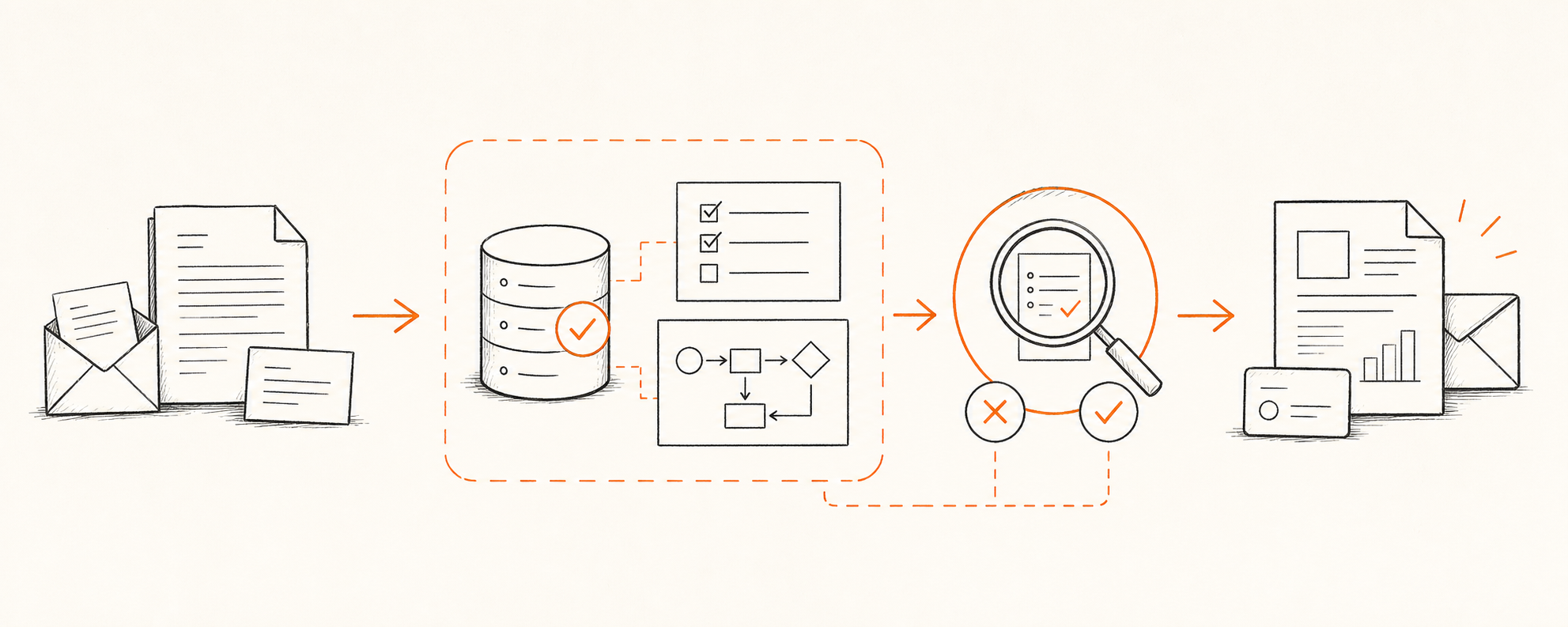
A careful route from opportunity to operation.
- 01
Observe
We examine the current task, repeated decisions, source material, hand-offs and exceptions.
- 02
Select
We choose a narrow opportunity where the useful outcome and responsible owner are clear.
- 03
Bound
We define permitted data, privacy constraints, human review, fallback and reasons to stop the workflow.
- 04
Prototype
We test the proposed behaviour on representative inputs before connecting it to everyday work.
- 05
Integrate
We build the agreed interface and hand-offs around the tools and responsibilities already in use.
- 06
Evaluate
We review output quality, failure cases and operational evidence before expanding the workflow.
Guardrails inside the design
A workflow should show where confidence ends.
The team needs to know what the system used, what it produced and when a person must intervene. We design those boundaries into the experience rather than hiding them in a technical note.
Defined purpose
A narrow task and expected result, with no vague mandate to automate everything around it.
Data minimisation
Only the information required for the agreed task is considered for the workflow.
Source visibility
Approved source material remains identifiable where people need to check an answer or output.
Human review
A named role remains responsible where output needs judgement, approval or customer impact.
Fallback behaviour
The workflow can hand work back to a person when information is missing or confidence is insufficient.
Representative evaluation
Testing includes normal, ambiguous and difficult examples from the agreed task boundary.
Operational signals
Useful logs and review points help the responsible team spot drift, faults and changing inputs.
Change control
Model, prompt, data and integration changes are treated as product changes that may need review.
What makes AI operable
The business owns the purpose, boundary and decision.
Workflow map
The task, inputs, output, hand-offs and human decision points made explicit.
Data boundary
Approved sources, excluded information and ownership responsibilities recorded.
Behaviour specification
The expected actions, limitations, escalation and fallback described in plain language.
Evaluation set
Representative examples and review criteria for checking the agreed workflow behaviour.
Implementation
The agreed interface, integration and workflow code organised for the delivery scope.
Operating guide
Responsibilities for monitoring, review, changes and stopping the workflow when needed.
Standards behind the work
Risk and accountability belong in the first conversation.
UK guidance treats AI and personal data as a governance and design concern, not merely a technical choice. We use a risk-based approach and revisit controls when the purpose or system changes.
Guidance on AI and data protection
UK guidance covering accountability, transparency, fairness, security and individual rights.
Read the primary sourceInformation Commissioner's OfficeData protection by design and by default
Why privacy and accountability should be considered from the start of a product or service.
Read the primary sourceInformation Commissioner's OfficeAI and data protection risk toolkit
A practical resource for identifying and controlling risks to people's rights and freedoms.
Read the primary sourceFAQ
Questions before using AI.
Where should a business use AI first?
Start with a repeated, bounded task where the current input, output, owner and failure cost can be understood. A high-volume task is not automatically a good candidate if mistakes are hard to detect or the information boundary is unclear.
Can this work with our current tools?
Possibly. We review the available APIs, data access, permissions and hand-offs before recommending an integration. Sometimes a lightweight step around the existing tools is more maintainable than replacing them.
How do you handle confidential or personal information?
We identify what the task needs, what should be excluded, who can access the workflow and which legal or policy decisions belong to the business and its advisers. No data source is assumed safe merely because a tool can connect to it.
Will AI make decisions automatically?
Not by default. We decide where assistance ends and human responsibility begins based on the task, risk and business context. Significant or customer-affecting decisions need an explicitly agreed review and escalation approach.
How do you know whether the workflow is accurate enough?
We define useful acceptance criteria and test representative normal, ambiguous and difficult examples. Evaluation is specific to the task; a general model benchmark does not prove a business workflow is dependable.
What if AI is not the right answer?
Then we recommend the simpler route. A clearer process, form, search experience or conventional integration may solve the problem with less cost, risk and maintenance.
Start with one task worth improving.
Bring the workflow, source information and the decision a person makes today. We will use the quote phase to shape a sensible first experiment.
Start a project