
Ecommerce websites
Make buying easier before adding more features.
We design ecommerce websites around how customers compare products and how your team manages what happens after an order. Catalogue structure, product content, storefront design and operations are planned as one connected service.

A shop is a decision system with operations behind it.
Customers need the right product, enough detail to choose it and clear expectations about delivery, returns and support. Your team needs product data, stock, orders and customer communication to remain manageable.
We work on both sides of that exchange. The storefront should help a person buy without hiding the operational consequences from the business running it.
For product businesses ready to make buying clearer
Treat the storefront and the operation as one connected service.
This work suits businesses launching an online shop, outgrowing a basic storefront or struggling with a catalogue that customers and staff find difficult to navigate. We start with products, decisions and fulfilment, not theme decoration.
What belongs together
Organise products, collections, options and filters around how customers browse rather than internal shorthand.
What makes this right
Give people the images, specifications, availability and policies needed to choose with confidence.
What happens next
Make basket, checkout, confirmation, fulfilment and support expectations clear across the whole order journey.
Ecommerce work, shaped around the operation
New Shopify stores
Plan the catalogue, core buying journey and operational responsibilities before configuring the storefront.
Discovery · Catalogue · Shopify · LaunchStorefront redesigns
Improve navigation, product pages and buying confidence without losing important product data or URLs.
Audit · UX and UI · Theme development · MigrationCatalogue architecture
Create a dependable model for products, variants, collections, attributes and reusable information.
Taxonomy · Product model · Filters · GovernanceProduct content systems
Define what every product page must explain and how your team should maintain accurate information.
Templates · Image rules · Specifications · WorkflowsCommerce integrations
Connect agreed marketing, merchant and operational tools only where they improve a defined part of the journey.
Merchant feeds · Email · Analytics · OperationsCommerce becomes an operating system
From a product list to a shop your team can run.
We turn product knowledge into a structured catalogue, build reusable buying patterns and connect the agreed hand-offs from discovery to fulfilment.
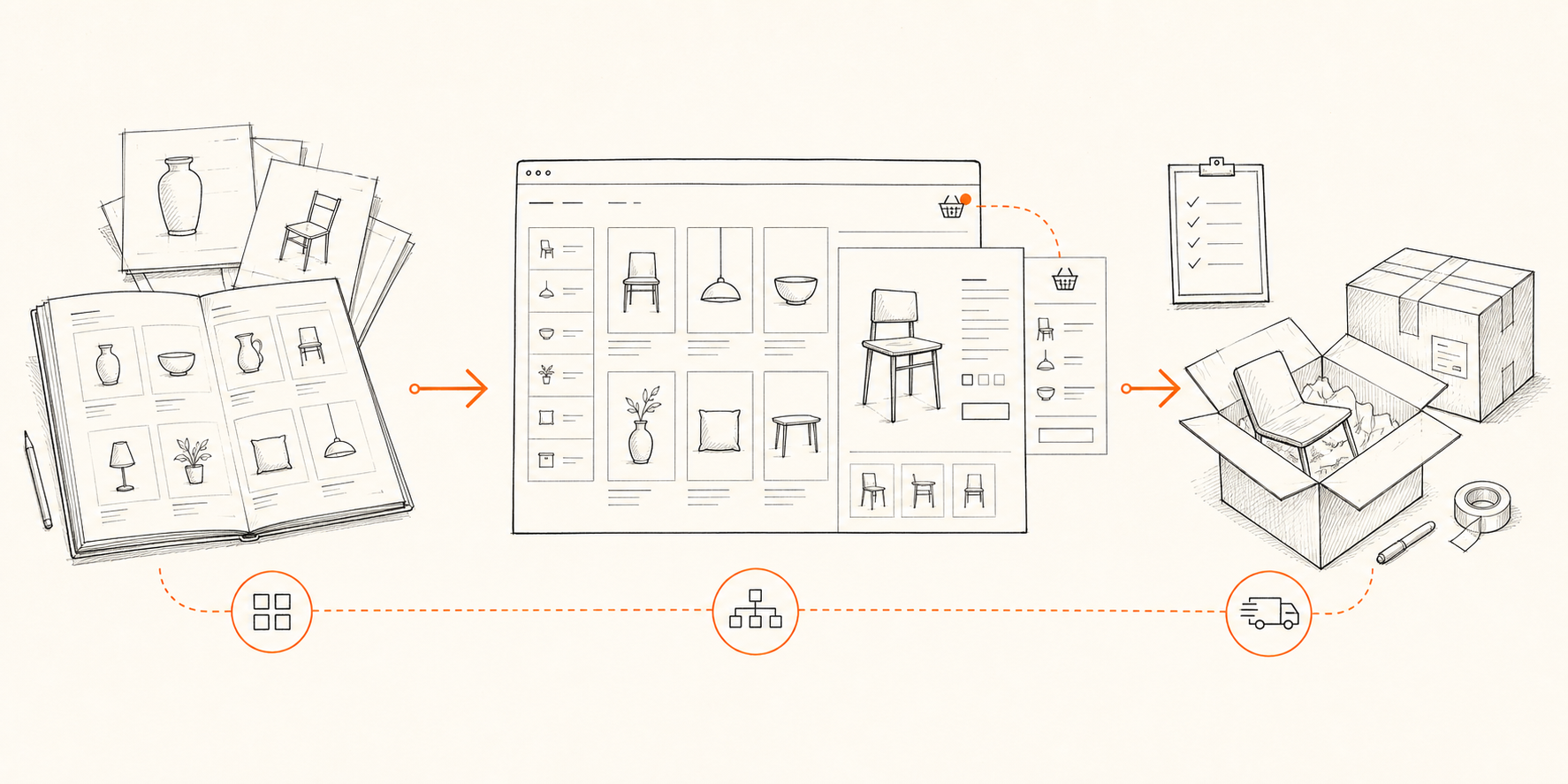
A commerce process from stockroom to screen.
- 01
Understand
We map the products, customers, fulfilment model, current tools and decisions the store must support.
- 02
Model
We define products, variants, collections, attributes and the source of each important piece of data.
- 03
Journey
We plan how people browse, compare, choose, buy and find help before designing the interface.
- 04
Build
We configure and develop the agreed Shopify storefront, reusable sections and required connections.
- 05
Prepare
We load agreed content, test representative products and confirm responsibilities for orders and updates.
- 06
Launch
We complete agreed checks, support release and document the routine work needed to keep the shop healthy.
Built for the entire order journey
The sale is only useful when the experience still works afterwards.
We treat product data, customer expectations and store operations as part of the interface. That keeps the storefront honest and reduces avoidable support work.
Clear product choices
Variants, availability and product differences presented where the decision is being made.
Useful product content
Descriptions, specifications, images and policies structured around real buying questions.
Mobile buying journeys
Navigation, product selection and basket actions designed deliberately for smaller screens.
Storefront performance
Images, scripts and app choices reviewed for their effect on important collection and product pages.
Accessible commerce
Labels, focus order, controls, errors and status information designed for a wider range of customers.
Search-ready products
Descriptive URLs, structured product information and crawlable catalogue paths where appropriate.
Operational ownership
Clear responsibility for prices, stock, orders, customer messages and routine content updates.
Measured additions
Apps and integrations selected for a defined need rather than installed because they are available.
What your team needs to operate
The storefront and the routine behind it should make sense.
Catalogue model
A clear structure for products, options, collections and reusable information.
Storefront system
Responsive templates and sections for the agreed customer journeys.
Content guidance
Practical rules for product copy, imagery, specifications and policy links.
Integration map
A record of agreed systems, data hand-offs and ownership boundaries.
Launch checklist
Agreed checks covering representative products, orders, messages and devices.
Operating guide
Routine guidance for product updates and the responsibilities agreed in scope.
Standards behind the work
Good commerce architecture starts with the catalogue.
The platform supports products, variants, collections and structured product data. We use those primitives deliberately and protect storefront performance as the catalogue grows.
Shopify Storefront Product model
The official model for products, variants, collections and extended product data.
Read the primary sourceShopify Developer DocumentationStorefront performance
Guidance for testing and reducing the performance impact on real storefront pages.
Read the primary sourceW3CWeb Content Accessibility Guidelines 2.2
The recognised standard used to inform accessible interfaces and interactions.
Read the primary sourceFAQ
Questions about ecommerce projects.
Do you build Shopify stores?
Yes. We can plan and implement a Shopify storefront when it fits the catalogue and operating model. The proposal explains the theme, custom development, product setup and integration responsibilities included in the work.
How much product information do we need before starting?
We need enough representative products to understand categories, variants, images, specifications and exceptions. We can define the model before every product is ready, but unclear or inconsistent source data must be resolved before a reliable launch.
Can you migrate products from an existing shop?
Migration can be included after we review the source data, URLs, variants, media and any custom fields. We agree what can move automatically, what needs cleaning and what should not be carried into the new store.
Do you set up payments, delivery and tax?
We can configure agreed platform settings and support the technical setup, but commercial, legal, tax and operational decisions remain with the business and its advisers. Responsibilities are made explicit in the quote phase.
Can you connect Google Merchant Center and email tools?
Yes, where those connections are part of the agreed scope and the required accounts, policies and product data are ready. We treat each integration as a separate data and ownership decision.
What happens after the store launches?
Your team receives guidance for the agreed routine work. Maintenance, new features, catalogue expansion and optimisation can be scoped separately once there is real evidence about how the store is being used.
Build a shop that works beyond checkout.
Bring the product range and the way orders are handled today. We will use the quote phase to shape a sensible ecommerce scope.
Start a project